
Artificial Intelligence has moved well beyond the research lab—but for many organizations, turning its potential into real business value remains a challenge.
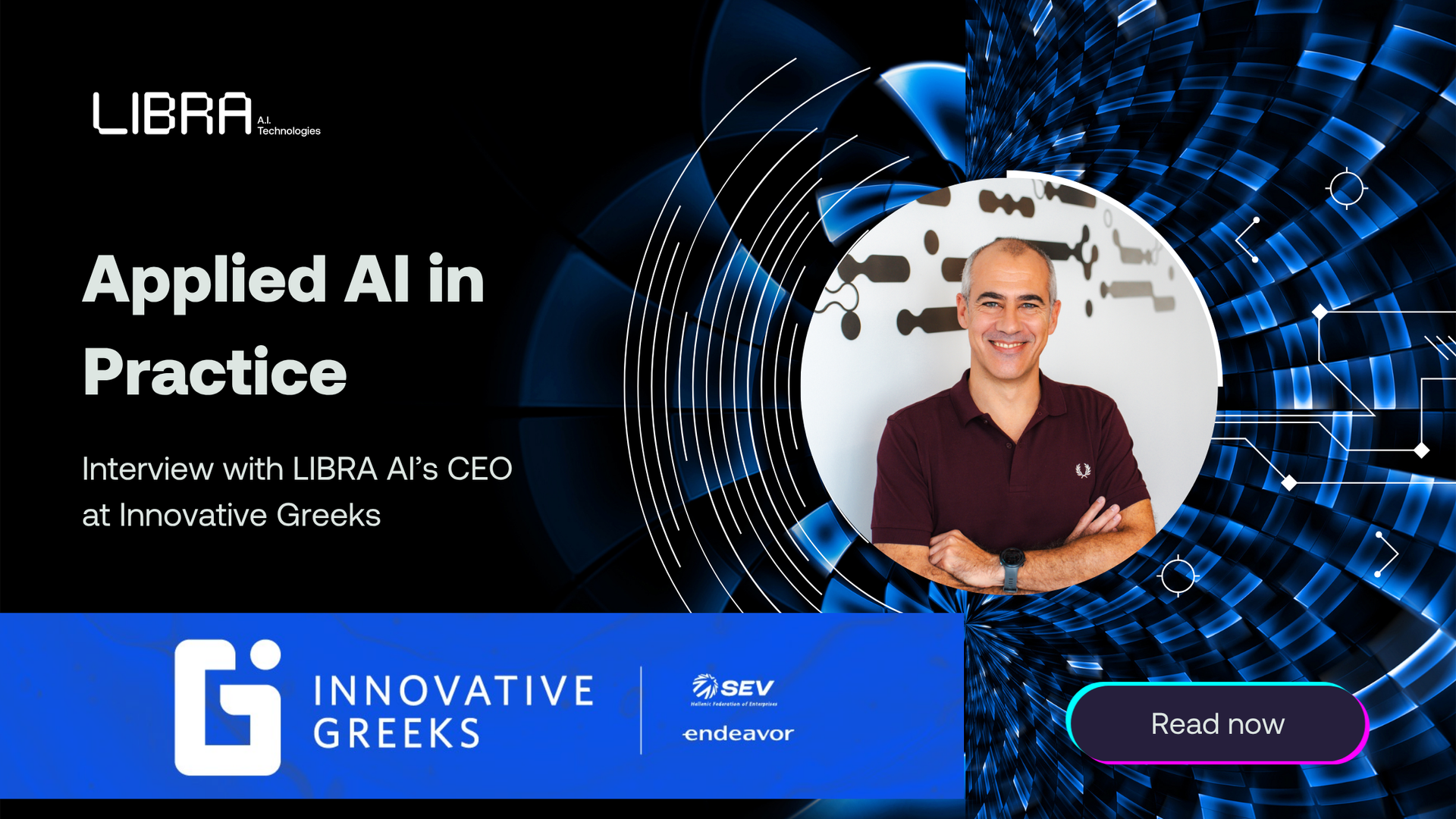
In a recent interview with #InnovativeGreeks, Yannis Kopsinis, co-founder and CEO of LIBRA AI Technologies, shares his perspective on what it really takes to make AI work in practice. Drawing on more than two decades of experience in Machine Learning, he reflects on the journey from early research to building solutions that operate in real-world environments.
At the core of this conversation is a clear idea: successful AI is not defined by complexity, but by relevance, usability, and measurable impact.
Bridging the Gap Between AI Potential and Business Reality
LIBRA AI was founded to address a persistent challenge in the market—the gap between what AI promises and what organisations are actually able to implement.
“AI was gaining momentum, but many organisations struggled to translate its potential into tangible outcomes,” Yannis explains.
From the beginning, LIBRA AI focused on bridging that gap. Rather than offering generic solutions, the company works closely with clients to design and implement fully customised AI systems that integrate seamlessly into existing operations and deliver measurable impact.
Moving Beyond the AI Hype
In a rapidly evolving field, staying grounded is part of the strategy. “At LIBRA AI, we don’t follow the hype, we build what works.”
This philosophy has shaped the company’s approach to every project: combining strong technical expertise with a deep understanding of business needs. The result is AI that is not only functional but also practical, scalable, and aligned with long-term goals.
What Sets LIBRA AI Apart
A key differentiator for LIBRA AI is its commitment to customisation and system-level thinking. Each solution is designed with the client’s specific environment, constraints, and objectives in mind.
This goes beyond building models. It’s about delivering complete, production-ready systems that create sustained value over time.
Behind this approach is a multidisciplinary team of highly-skilled data scientists, engineers, and strategists who combine research-driven thinking with hands-on execution.
Lessons from Building in a Fast-Moving Industry
One of the biggest challenges for LIBRA AI has been keeping pace with the rapid evolution of AI while scaling effectively.
The approach has been to invest consistently in continuous learning and research, including participation in large-scale European initiatives such as Horizon 2020. This allows emerging technologies to be tested and applied in ways that are relevant to real business environments.
A key lesson from this experience is that successful AI adoption depends on alignment, clear expectations, a shared understanding of the technology, and organisational readiness from the outset.
AI in Greece: A Practical Opportunity
Yannis Kopsinis offers a clear, practical view of Greece’s role in the AI landscape.
The country combines strong technical talent with key industries—such as maritime, energy, logistics, and manufacturing—where AI can have an immediate impact. What’s needed is a structured environment that supports experimentation, collaboration, and real-world implementation.
As he notes, AI is already a differentiator for businesses ready to adopt it.
Read the Full Interview
This conversation offers deeper insights into the philosophy, challenges, and vision behind LIBRA AI.
Read the full interview on InnovativeGreeks website: (link)